
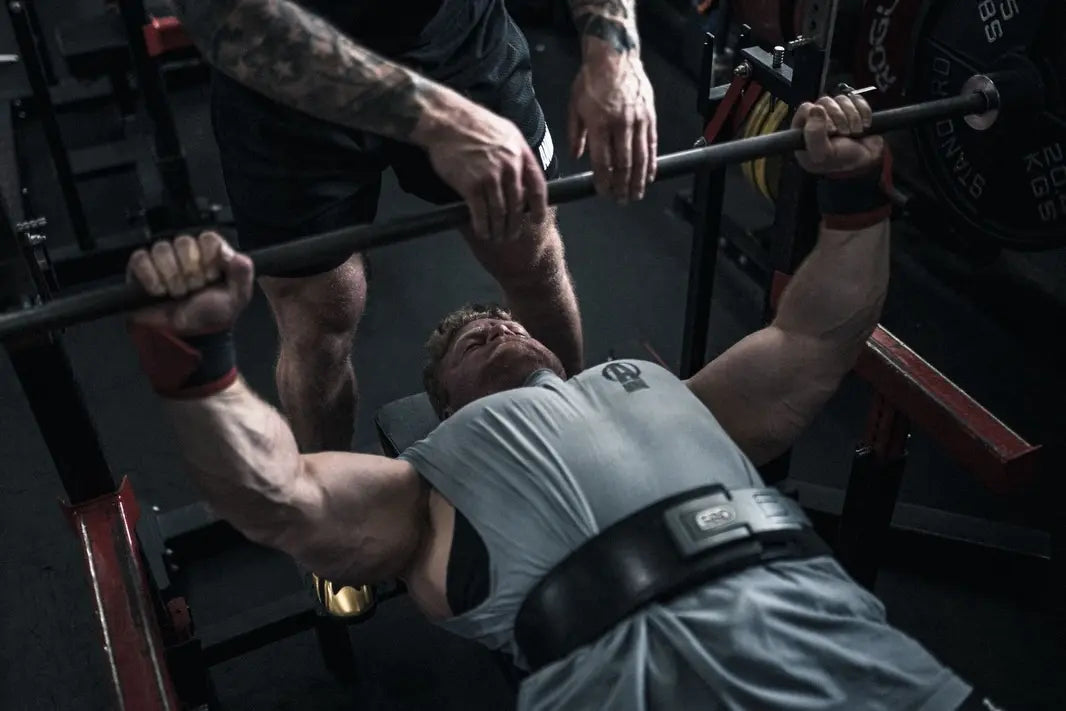
Every serious training programme is built on one principle. Not the exercises. Not the split. Not the rep scheme. Progressive overload.
Most people know the term. Fewer people actually apply it properly. And that gap is the difference between lifters who keep progressing year after year and lifters who have looked the same for the last eighteen months.
Here is what it actually means — and the five levers most people are not using.
1. WHAT PROGRESSIVE OVERLOAD ACTUALLY IS
Progressive overload is the gradual increase of stress placed on the body during training. Your muscles adapt to the demands placed on them. Keep the demand the same and the adaptation stops. Increase the demand — systematically, over time — and the body has no choice but to keep adapting.
This is the entire mechanism behind getting stronger and building muscle. Not a supplement. Not a specific programme. Not a training split. Progressive overload is the underlying driver, and everything else is a delivery mechanism for it.
The problem is most people reduce this to a single idea: add more weight to the bar. That is one lever. It is not the only one — and relying on it exclusively is exactly why so many people plateau.
2. WHY "JUST ADD WEIGHT" STOPS WORKING
Adding weight is the most obvious form of progressive overload, and it works — for a while. Early in a training career, strength gains come fast and loading the bar consistently is realistic.
But strength gains do not scale linearly forever. As you approach your genetic and training-age-adjusted ceiling, adding weight every single session becomes impossible. This is where most people stall. They keep trying to add weight, fail to do so consistently, get frustrated, and either burn out or plateau for months without realising there were other tools available the entire time.
Weight on the bar is one lever out of several. Understanding the others is what allows continued progress long after linear loading stops being realistic.
3. THE FIVE LEVERS OF PROGRESSIVE OVERLOAD
Load. The most obvious lever — increasing the weight lifted for a given rep range. Effective, especially early in a training career, but limited by how quickly you can realistically add weight without compromising form.
Volume. Increasing total work done — more sets, more reps, or both. If you cannot add weight this session, adding an extra set at the same weight is still progressive overload. Total volume is one of the most underused levers for intermediate and advanced lifters.
Density. Doing the same amount of work in less time — shorter rest periods, more work per session. This increases the metabolic and cardiovascular demand of a session without touching the weight on the bar at all.
Range of motion. Increasing the range through which a muscle is worked — deeper squats, fuller stretch on a curl, a longer eccentric on a row. A muscle worked through a greater range under load is subjected to a greater training stimulus, even at the same weight.
Technique and control. Improving execution — slower eccentrics, better mind-muscle connection, more controlled tempo, reduced momentum. Two people lifting the same weight for the same reps are not doing the same amount of work if one is using momentum and the other is controlling every inch of the movement.
Five levers. Most people are only pulling one. The lifters who keep progressing for years are the ones who understand they have four other tools available the moment the first one stops moving.
4. HOW TO ACTUALLY APPLY THIS
Progressive overload does not need to happen in every session, on every exercise, across every lever simultaneously. That is a recipe for burnout, not progress.
Track your training. You cannot progressively overload what you are not measuring. Weight, reps, sets, and how the session felt. Without a log, progression becomes guesswork.
Pick your primary lever per phase. A block focused on adding load. A block focused on adding volume. A block focused on tightening technique and increasing range of motion. Rotating which lever you are prioritising keeps progress moving without demanding constant, unsustainable increases across every variable at once.
Accept that progress is not always visible in the mirror. An extra rep. A slightly longer range of motion. Better control on the eccentric. These are all progressive overload, even when the number on the bar has not moved. Chasing only load-based progress is why people think they have plateaued when they have actually just stopped tracking the right variable.
Deload when needed. Progressive overload without periodic recovery leads to accumulated fatigue that eventually stalls progress across every lever. A planned deload is not a step backward — it is what allows the next block of progressive overload to actually work.
5. WHERE CREATINE FITS
Progressive overload requires you to consistently produce more output — more weight, more reps, more volume — than you did before. That requires the physical capacity to do so.
Creatine is the most researched performance supplement in existence, and its primary mechanism is directly relevant here. It increases phosphocreatine stores in muscle tissue, which supports ATP regeneration during high-intensity effort. In practical terms, that means more reps at a given weight, better performance across sets, and a greater capacity to push the loads and volumes that drive progressive overload in the first place.
It does not replace the training principle. It supports your ability to execute it consistently, session after session.
CONCLUSION
Progressive overload is not complicated, but it is more than adding weight to the bar. Load, volume, density, range of motion, technique — five levers, and the lifters who keep progressing for years are the ones using more than one of them.
Track your training. Rotate your focus. Deload when your body asks for it. And give yourself the physical capacity to execute the plan through consistent, well-supported training.
That is the standard.
— RED SUPPS